Every winter, northern India transforms into a toxic landscape of dense smog, hazardous particulate matter, and plummeting Air Quality Index (AQI) readings. While public discussion around air pollution typically peaks during these crisis months, the underlying degradation of ambient and indoor air quality remains a year-round, enterprise-level challenge across the subcontinent. What was once framed strictly as a public health disaster or an environmental policy failure has rapidly evolved into a critical operational concern for businesses, real estate developers, and industrial operators.
Highlighting the growing venture interest in hardware-driven environmental solutions, Indian clean-tech startup YOGa Clean Air has raised ₹20 Crore (approximately $2.1 million) in its Series A funding round. The investment round was led by Info Edge Ventures, alongside participation from select angel investors and existing supporters. The capital injection marks a notable milestone for India’s emerging environmental technology sector, which has historically struggled to attract early-stage venture backing compared to high-margin software, fintech, and consumer internet businesses.
The fresh influx of capital will primarily be deployed to expand the company’s manufacturing capacity, accelerate research and development (R&D) into proprietary filtration technologies, and scale its commercial sales footprint across major urban and industrial hubs in India.
The Air Quality Crisis as an Enterprise Reality
To understand the strategic rationale behind Info Edge’s investment, one must look past consumer-facing household air purifiers and examine the massive, underserved commercial and industrial air management sector. India is home to 83 of the world's 100 most polluted cities, according to global air quality metrics. While consumer awareness has led to a boom in tabletop residential air purifiers, these consumer appliances do little to solve the systemic air quality challenges faced by large manufacturing facilities, commercial office complexes, hospitality chains, and healthcare infrastructure.
Poor indoor air quality directly impacts labor productivity, increases absenteeism, accelerates equipment corrosion in specialized facility environments, and poses long-term liability risks for employers. Furthermore, as international corporate clients demand stricter Environmental, Social, and Governance (ESG) compliance from their Indian supply chain partners, factory managers are finding that baseline ventilation systems are no longer sufficient to meet global workplace safety and environmental standards.
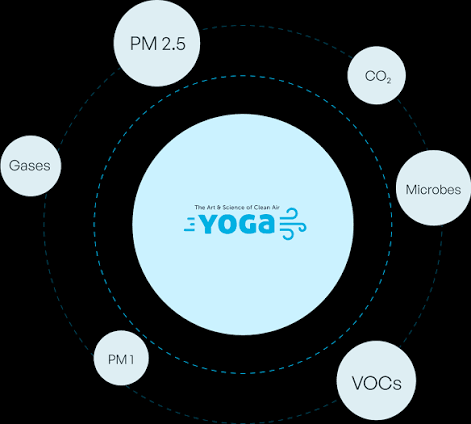
YOGa Clean Air has positioned itself at the intersection of these industrial pain points. By developing scalable, enterprise-grade air purification and treatment systems, the startup aims to provide continuous, high-efficiency filtration tailored to the unique particulate composition of Indian environments—which often feature high concentrations of dust, heavy industrial emissions, and fine particulate matter (PM2.5 and PM10) that standard off-the-shelf Western systems fail to handle efficiently over extended operational cycles.
Decoding Info Edge’s Bet on Hardware and Clean Tech
Info Edge, best known for its early and lucrative bets on consumer internet giants like Zomato and PolicyBazaar, has spent the last few years diversifying its venture investments through dedicated funds. Their backing of YOGa Clean Air signals a deliberate shift toward capital-efficient hardware, deep-tech, and sustainable infrastructure solutions that address fundamental structural challenges in emerging markets.
For venture funds operating in India, climate tech has traditionally presented a dilemma. SaaS (Software-as-a-Service) models offer predictable recurring revenues and high software margins, whereas deep-tech clean hardware requires significant upfront capital expenditure (CapEx), long sales cycles, complex supply chains, and extensive field testing. However, the market dynamics are shifting.
With corporate India increasingly forced to adhere to SEBI’s Business Responsibility and Sustainability Reporting (BRSR) framework—which mandates the top 1,000 listed companies to report their ESG performance—sustainability initiatives are moving from corporate social responsibility (CSR) side projects to boardroom-level compliance mandates. VCs recognize that startups delivering measurable, audit-ready environmental improvements stand to capture long-term enterprise contracts.
Info Edge's entry into this round provides YOGa Clean Air with not just financial runway, but also institutional credibility. In a B2B selling environment where procurement officers are notoriously risk-averse, having a premier venture capital name on the cap table can substantially shorten enterprise sales cycles.
B2B versus B2C: The Commercial Shift in Air Purification
The air purification landscape in India has historically been dominated by consumer electronics brands offering standalone home units. However, the B2C air purifier market in India suffers from extreme seasonality. Sales surge dramatically between October and February across the Indo-Gangetic plain, only to collapse during the monsoon and summer months. This demand volatility makes inventory management and operational scaling exceptionally difficult for consumer-only hardware brands.
In contrast, the B2B and industrial clean-air sector offers a far more stable, recurring revenue model. YOGa Clean Air’s strategic focus on commercial spaces, manufacturing plants, and large-scale infrastructure projects aligns with a recurring servicing and maintenance business. High-capacity filtration systems require periodic filter replacements, sensor calibration, real-time monitoring software subscriptions, and preventative maintenance.
By integrating proprietary hardware with IoT-enabled air quality monitoring software, startups like YOGa Clean Air can transition from a one-off hardware vendor into a long-term service provider. This "Clean Air-as-a-Service" model provides predictable revenue streams while allowing corporate clients to treat clean air expenditure as an operational expense (OpEx) rather than a heavy, upfront capital outlay.
Regulatory Drivers and Policy Tailwinds
The regulatory landscape in India is undergoing a quiet revolution regarding air emission standards and ambient working conditions. The central government’s National Clean Air Programme (NCAP), launched with the target to reduce particulate matter concentration across non-attainment cities, has pushed municipal bodies and state pollution control boards (SPCBs) to tighten enforcement.
Key policy and market tailwinds driving clean-tech adoption include:
- Strict Industrial Emission Monitoring: State pollution boards are mandating continuous emission monitoring systems (CEMS) for heavy industries, forcing factory operators to install advanced scrubbing and filtration technologies.
- Commercial Real Estate Certification: Grade-A office spaces in tier-1 cities like Bengaluru, Mumbai, and Delhi-NCR are competing for international tenants by acquiring green building certifications such as LEED and WELL, both of which require strict indoor air quality standards.
- Occupational Health Regulations: Emerging amendments to workplace safety guidelines are compelling employers to ensure safe ambient air environments in hazardous industries, including chemical processing, textile manufacturing, and heavy engineering.
Startups capable of providing localized, cost-effective, and engineered solutions to comply with these expanding regulations are uniquely positioned to capture market share from expensive imported equipment providers.
The Hardware Challenge: Scaling Deeptech Manufacturing in India
While the ₹20 Crore Series A funding provides YOGa Clean Air with critical momentum, the path forward for hardware-focused clean-tech startups in India is fraught with execution risks.
First, scaling hardware manufacturing requires tight quality control, resilient component sourcing, and efficient supply chain management. Relying on imported specialized filter media or precision sensors can expose startups to currency fluctuations and geopolitical supply bottlenecks. To build a defensible moat, YOGa Clean Air will need to continuously invest in localized supply chains and proprietary R&D to maintain margin superiority over incumbent multinational players.
Second, enterprise sales in the industrial sector remain notoriously slow. Converting pilot projects into facility-wide rollouts across multiple manufacturing plants requires deep domain expertise, extensive field testing data, and relentless enterprise sales execution. The company must balance its capital deployment between long-term technology development and immediate salesforce expansion.
Finally, customer retention in the B2B space hinges on demonstrated performance. Unlike consumer gadgets where users rarely measure filter efficiency independently, industrial clients deploy continuous sensor arrays to verify that clean-air systems deliver promised particulate reduction levels. Product reliability under harsh ambient conditions will ultimately determine the startup's multi-year retention metrics.
The Broader Outlook for Indian Climate Tech
For years, India’s startup story was written almost exclusively in code—e-commerce platforms, payment gateways, gig-economy logistics, and SaaS applications dominated venture capital flows. The successful funding of physical deep-tech ventures like YOGa Clean Air points toward a maturing ecosystem where venture capital is willing to back long-term engineering solutions aimed at hard real-world problems.
As urbanization accelerates and industrial output expands under national initiatives like "Make in India," environmental remediation technologies will become mandatory components of urban and industrial infrastructure. Clean air is no longer viewed merely as a luxury for affluent urban homes, but as essential infrastructure for a modernizing economy.
YOGa Clean Air’s Series A round is a small but important step toward proving that clean-tech hardware developed in India, for Indian environmental conditions, can build a viable, venture-backed commercial enterprise. Whether the company can efficiently navigate the capital-intensive scaling phase will serve as an important bellwether for the next wave of Indian climate-tech hardware founders.