For decades, the name Akai Professional has been synonymous with the rhythmic backbone of modern music. Ever since Roger Linn collaborated with the company in the late 1980s to create the iconic Music Production Center series, Akai has set the gold standard for pad-based sampling and beat-making. However, as the digital music landscape shifts toward software flexibility, open-source hardware, and rapid prototyping, music tech legacy giants are forced to re-evaluate their relationship with modern software developers. Akai's latest move signals a dramatic pivot in this direction: the legacy manufacturer is leaning heavily into open-source software and community-driven modifications for its upcoming hardware, the MPC Sample Key.
In an unprecedented move for a company that historically guarded its proprietary hardware ecosystems with tight control, Akai is distributing pre-release units of the unannounced MPC Sample Key directly to custom firmware developers, hackers, and software modders. By embracing the growing trend of community-driven design, Akai isn't just selling a piece of hardware; it is inviting the open-source community to define what the device can actually do.
Rethinking the Classic MPC Workflow
To understand why the MPC Sample Key represents a shift in strategy, one must look at how the device departs from classical MPC design philosophy. The traditional MPC experience revolves around sixteen velocity-sensitive grid pads—a layout that reshaped hip-hop, electronic, and pop production over four decades. While Akai recently introduced keyboard-heavy devices like the MPC Key 37 and MPC Key 61, those premium instruments retained the traditional grid pads alongside a full piano bed.
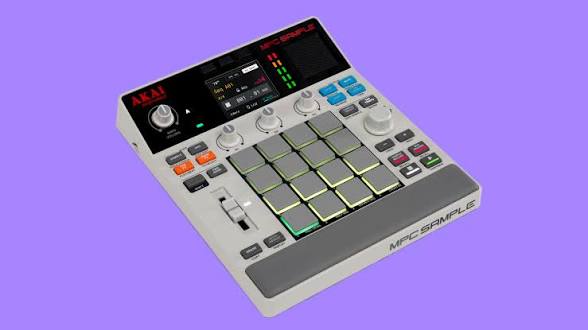
The MPC Sample Key takes a different path entirely. Ditching the signature 4x4 pad matrix, the device relies on a compact keyboard keyboard layout paired with standard performance controls like pitch and modulation wheels. Rather than triggering drum hits on rubber pads, users play back multi-sampled instruments, single-shot chops, and melodic loops directly across the keys. It is a form factor designed to bridge the gap between traditional portable synthesizers and dedicated phrase samplers.
Underneath the hood, the unit shares architectural roots with Akai's modern standalone sampling family, but its user interface and firmware require distinct adaptations to handle piano-style navigation and pitch shifting. Instead of retrofitting its standard closed-source operating system onto this altered layout, Akai opted to open up the codebase, inviting third-party creators to rebuild the control scheme from the ground up.
The Rise of Vibe Coding and Hackable Music Tech
Akai’s decision to open-source the MPC Sample Key firmware coincides with the broader rise of custom software hacking in electronic music gear. Over the last decade, musicians have increasingly gravitated toward open, modular, and hackable platforms like the Monome Norns, Electro-Smith Daisy, and the Raspberry Pi-powered Zynthian. Creators are no longer satisfied with static features dictated by corporate roadmap cycles; they want bespoke firmware tailored to hyper-specific live performance setups or generative algorithmic composition.
By granting early access to open-source developers, Akai is capitalizing on the modern phenomenon of creative software modding. Developers can rapidly prototype synth engines, custom sequencers, and alternative UI layouts using higher-level scripting languages and modern coding tools—a practice growing in popularity across the maker community. Instead of spending years developing niche features in-house, Akai is turning its user base into a decentralized R&D department.
This open ecosystem approach provides immediate advantages for early adopters. Out of the box, an open-source MPC Sample Key could theoretically boot into a traditional sampling environment, a granular synthesizer, a microtonal keyboard tuner, or a dedicated MIDI control surface for modular rigs, simply by swapping out the firmware stored on an internal flash card.
Moving Away from the Walled Garden
Historically, mainstream music hardware manufacturers treated custom firmware with extreme hostility. Unofficial modifications often voided warranties, and companies actively used software updates to block homebrew software. The closed-garden model allowed brands to lock customers into proprietary expansion packs, software plugins, and subscription features.
However, the economics of hardware development have shifted dramatically. Building and maintaining complex operating systems for embedded audio devices is notoriously expensive. Closed software often leads to delayed bug fixes, abandoned legacy products, and consumer frustration when hardware hits an arbitrary end-of-life cycle. By providing official open-source firmware repositories, Akai mitigates these ongoing software burdens while extending the shelf-life of the physical hardware infinitely.
This open-access mindset also signals a structural change in how hardware makers view intellectual property. The value is no longer locked solely inside proprietary software code; it resides in the physical quality of the chassis, the tactile response of the keybed, the low-latency audio converters, and the reliability of the industrial design. If the hardware is robust, the open-source community will ensure the software remains relevant for decades.
What This Means for the Future of Music Hardware
Akai's pivot toward hackable firmware creates a fascinating precedent for the rest of the electronic instrument industry. Companies like Korg have previously experimented with open platforms—such as the logueSDK found in the Prologue and Minilogue xd—which allowed users to load custom digital oscillators and effects. However, Akai bringing an open framework to its core line of sampling products marks a far more aggressive commitment to community software.
If the MPC Sample Key proves commercially viable, competing manufacturers such as Roland, Novation, and Native Instruments may face pressure to open up their own embedded platforms. A ecosystem where users can cross-compile software modules across hardware platforms could radically democratize audio engineering software.
Moreover, it redefines the relationship between musicians and their tools. The boundary between a music producer and a software developer continues to blur. As young creators grow up experimenting with code, microcontrollers, and digital signal processing, the demand for adaptable, transparent, and modifiable hardware will only increase.
Open Questions and Potential Pitfalls
While the open-source direction promises unprecedented flexibility, it also raises practical questions regarding support and reliability. For working musicians and touring artists, stability is paramount. A crash during a live festival set caused by an unverified community firmware patch could quickly ruin a reputation. Akai will likely need to maintain a clear line between its official, battle-tested factory software and community-built modifications.
There is also the question of hardware limitations. While open-source code allows for creative freedom, embedded microprocessors have strict thermal, memory, and processing constraints. How much computational room the MPC Sample Key leaves for heavy third-party software synthesis remains to be seen once official hardware specifications are finalized.
Despite these challenges, Akai’s strategy is a breath of fresh air in an industry often stifled by incremental updates and locked ecosystems. By trusting developers, modders, and musicians to tear apart and rebuild its software, Akai is ensuring that the iconic legacy of the MPC continues to evolve alongside the modern open-source movement. The MPC Sample Key may lack the famous 16-pad grid that built the brand, but its open firmware could make it one of the most versatile compact instruments Akai has ever released.